
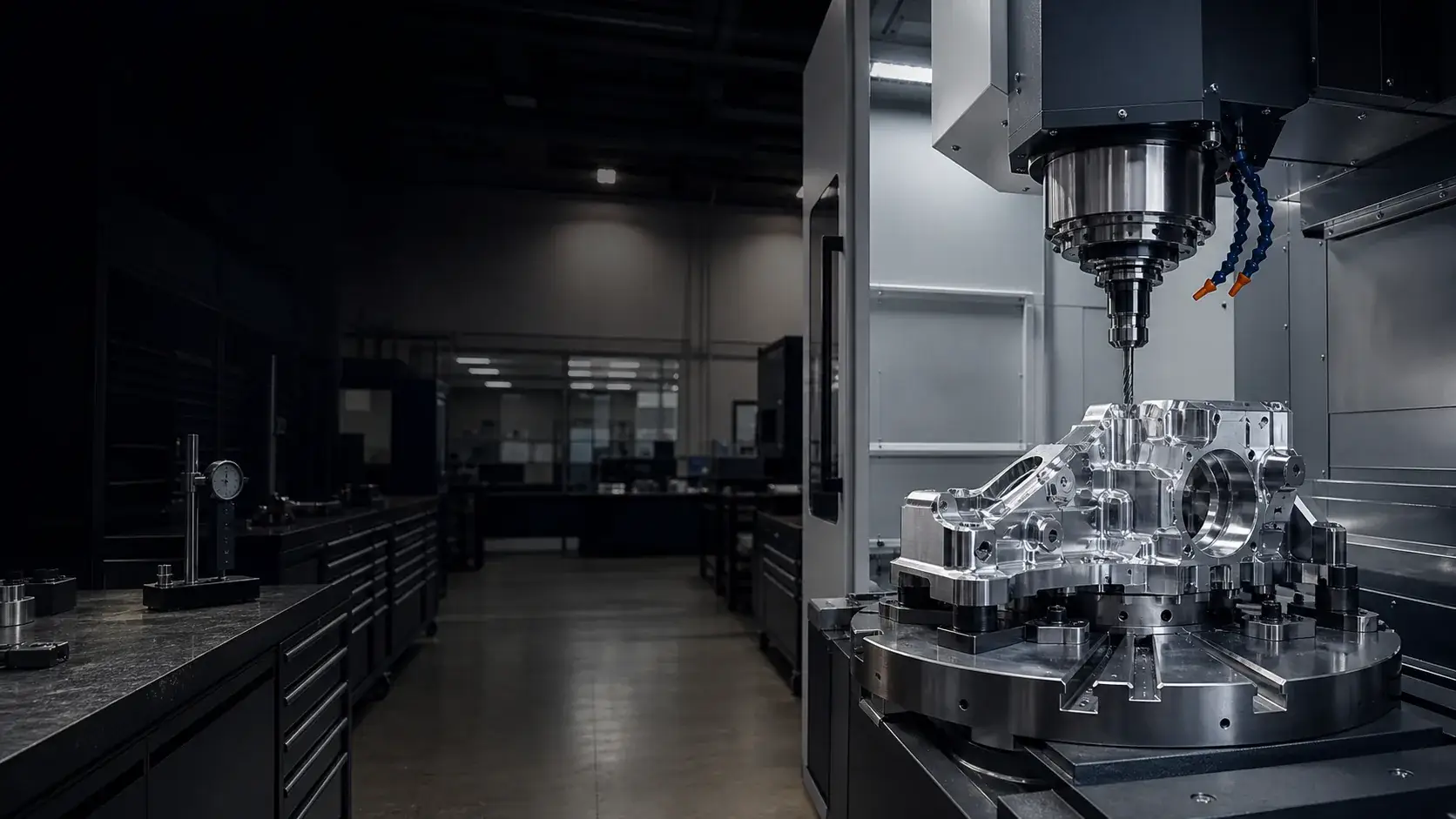
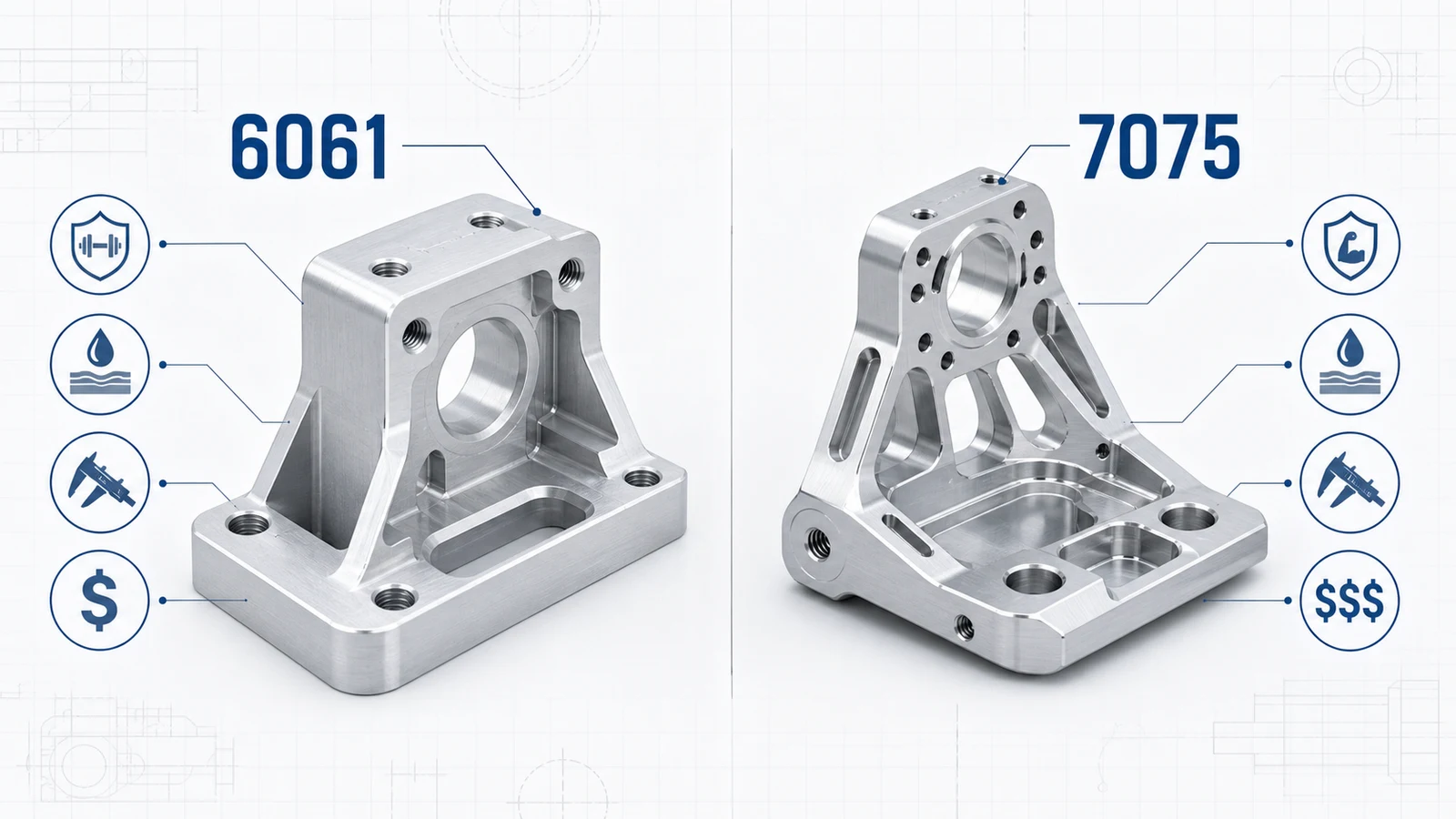
6061 and 7075 are both excellent CNC machining alloys, but they solve different engineering problems. Many RFQs simply say “aluminum” or list 6061 by habit. That works for brackets, housings, plates, and most commercial equipment parts. It is not enough when the part is load-bearing, fatigue-sensitive, exposed to corrosion, or required to match a cosmetic anodized appearance.
For buyers, the right question is not which alloy is better. The better question is which alloy protects the function of the part with the least machining, finishing, inspection, and supply risk.
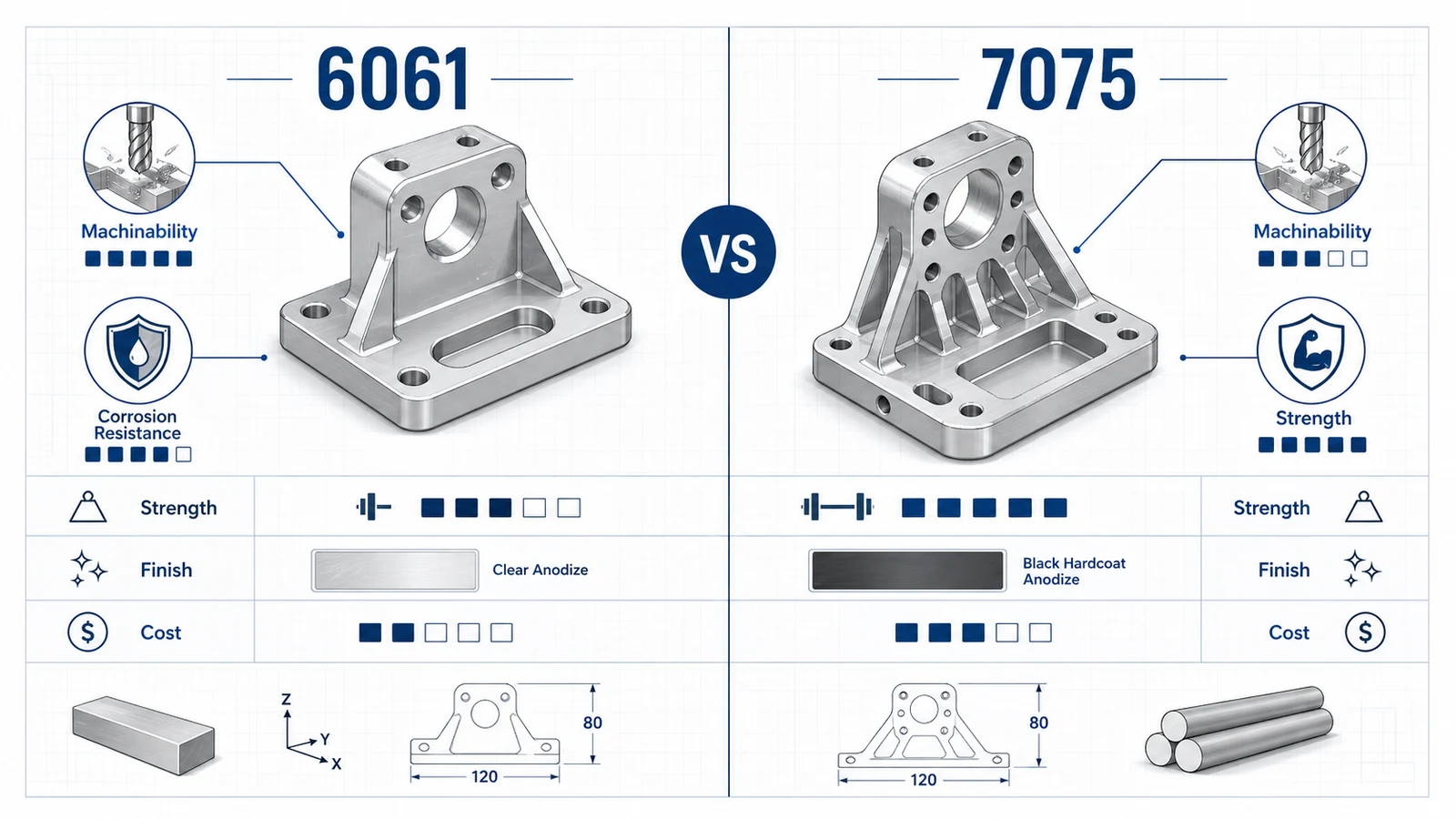
Quick comparison for CNC machined aluminum parts
| Decision point | 6061-T6 | 7075-T6 |
|---|---|---|
| Strength | Medium-high for general structural parts | Very high, often chosen for aerospace, robotics, and loaded brackets |
| Machinability | Excellent and forgiving | Excellent, but demands more attention to stress, burrs, and finish planning |
| Corrosion resistance | Better natural corrosion resistance | Lower corrosion resistance, usually needs finish protection |
| Anodizing appearance | More uniform clear and black anodize | Darker, sometimes less uniform anodize tone |
| Typical cost | Lower material cost and wider availability | Higher material cost and more sourcing control required |
| Best fit | Enclosures, plates, general brackets, fixtures, manifolds | High-load arms, mounts, lightweight structural parts |
Use the table as a first filter. The final decision should still include geometry, finish, tolerances, and annual volume.
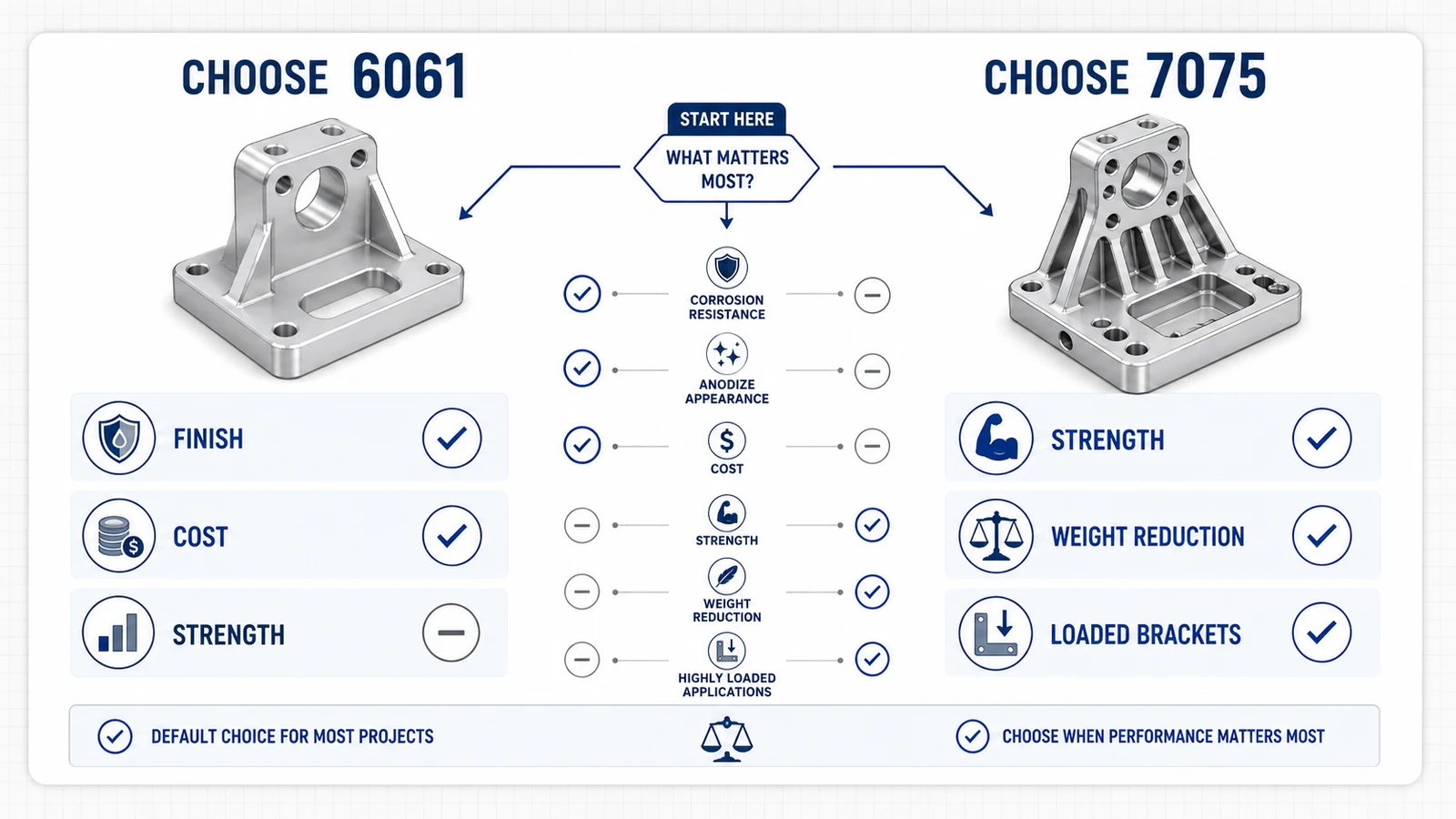
When 6061 is the better default
6061-T6 is the default alloy for many custom aluminum CNC parts because it balances strength, machinability, corrosion resistance, and finishing. It machines cleanly, deburrs well, accepts tapped holes reliably, and is available in plate, bar, and extrusion forms. For housings, machine covers, instrument brackets, panels, spacers, and moderate-load fixtures, 6061 is usually the lowest-risk choice.
6061 is also easier to specify when cosmetics matter. If the part needs clear anodize, bead blast plus clear anodize, or consistent black anodize across a production batch, 6061 gives the finishing team a more predictable starting point than 7075. That matters for visible aluminum parts such as CNC machined housings and enclosures where the surface is part of the product experience.
Choose 6061 when the part is stiffness-driven rather than strength-driven. A thick 6061 plate may deflect less than a thin 7075 part simply because geometry dominates material strength. If the design can meet load requirements with reasonable wall thickness and ribbing, 6061 often keeps cost and finish risk down.
When 7075 is worth the extra cost
7075-T6 is selected when the part needs a high strength-to-weight ratio. The alloy is common in aerospace tooling, robotics arms, structural brackets, actuator links, end-of-arm tooling, and compact load-bearing components where 6061 would require too much section thickness.
The benefit is real. 7075 can provide roughly double the yield strength of 6061-T6, depending on specification and temper. That can let a designer reduce weight, keep a bracket compact, or protect a threaded joint in a loaded assembly. For robotics aluminum CNC machining, 7075 is often justified when acceleration, payload, and stiffness all matter.
The tradeoff is that 7075 needs more deliberate finishing and corrosion planning. It is not the alloy to leave bare in humid or corrosive environments. If the part will be handled, installed outdoors, or exposed to coolant, specify anodize, hardcoat anodize, chem-film, or another approved protective finish.
Machinability and tolerance behavior
Both alloys machine well, but the machining plan changes. 6061 is forgiving during roughing and finishing, which helps with general tolerance work. 7075 cuts crisply and can hold fine details, but high-strength stock may show more stress movement after heavy material removal.
For pocketed plates, thin structural arms, and parts with asymmetric stock removal, ask the supplier to review stress relief, roughing strategy, and inspection timing. A part that measures flat in the vise can move after unclamping. That is not only a 7075 issue, but 7075 applications are often more sensitive because the parts are lighter, thinner, and more loaded.
If flatness is critical, include datums and a flatness callout on the PDF drawing. Do not rely on a general block tolerance to communicate functional flatness.
Anodizing and appearance
6061 is usually the safer choice for clear anodize. It produces a cleaner, brighter aluminum tone and more consistent lot-to-lot results. 7075 can anodize successfully, including black anodize and hardcoat, but clear anodize may look darker or slightly grey. That may be acceptable for internal structures and machine parts, but it can surprise teams expecting a bright cosmetic finish.
If the assembly contains both 6061 and 7075 visible components, do not expect them to match under clear anodize. Either keep visible parts in one alloy family, choose black anodize, or approve a visual range before production.
Review the anodized aluminum CNC machining guide before sending a drawing that combines tight fits with anodize thickness. Film growth can affect bores, slots, threads, and press fits.
Cost and supply implications
7075 usually costs more at the material level and may also add inspection and finishing control. The price difference is not only the plate or bar. It can include material certificates, controlled sourcing, extra setup planning, more careful deburring, and finish risk if cosmetics are important.
6061 is widely stocked and generally faster to source. For prototypes, pilot runs, and price-sensitive production parts, that can shorten lead time. For production programs, ask whether approved alternates are allowed. Some teams specify “6061-T6 or 6082-T6 allowed” for non-cosmetic European supply, while other teams lock 6061 only to control finish appearance.
RFQ checklist
Before requesting a quote, include:
- STEP or STP model plus a PDF drawing.
- Alloy and temper, such as 6061-T6 or 7075-T6.
- Critical dimensions and datums, not only general tolerances.
- Finish requirement, including clear, black, hardcoat, chem-film, or as-machined.
- Cosmetic expectations if multiple parts must match.
- Load case or application notes if the supplier may suggest an alloy change.
For most machined aluminum parts, start with 6061 unless the design has a documented strength, weight, or fatigue reason to move to 7075. Use 7075 when that reason is clear, then specify finishing and inspection tightly enough that the manufacturing process supports the alloy choice.