
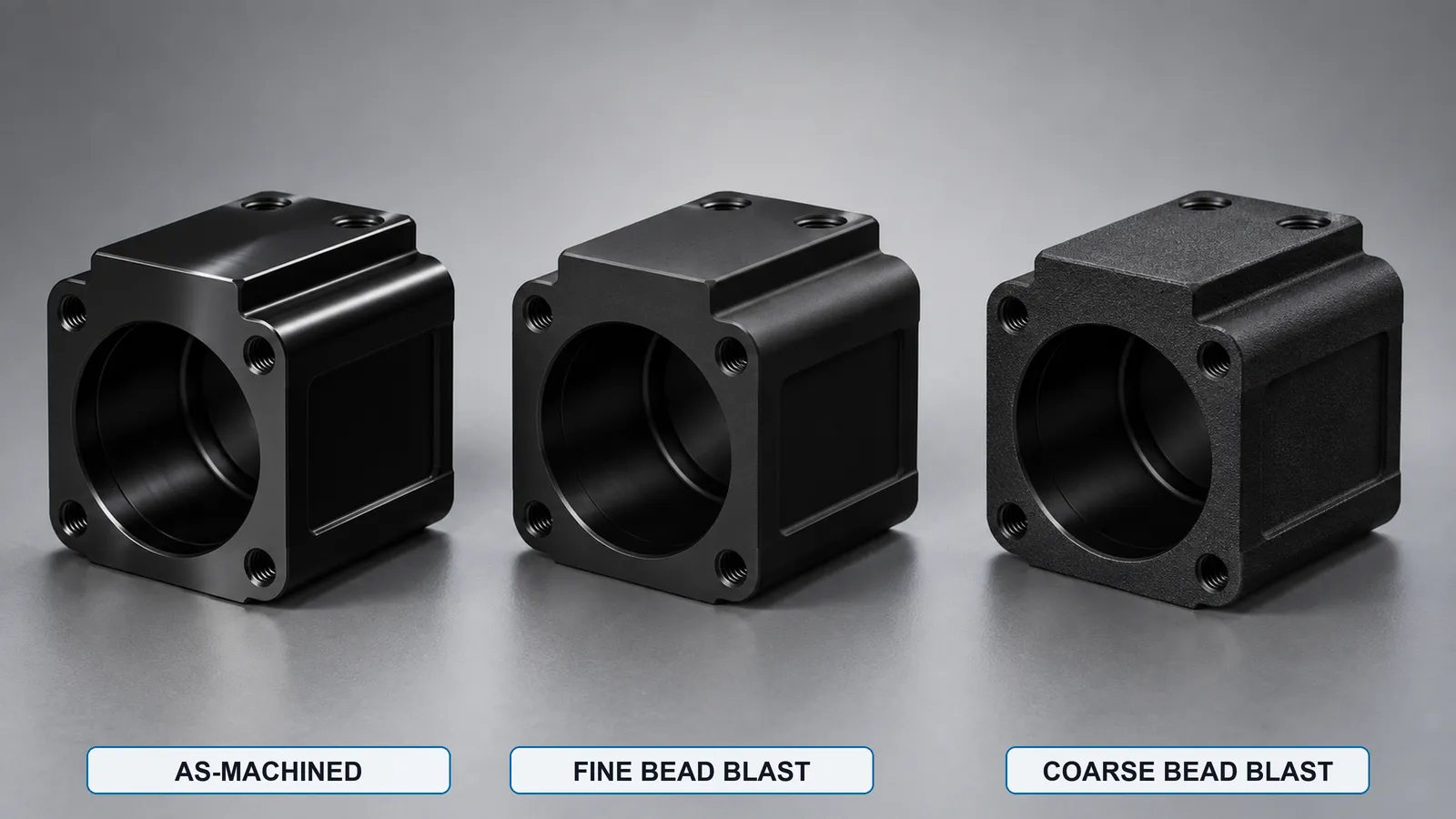
Direct answer: On a black anodized aluminum part, gloss and color come from two different places, and a drawing has to control both separately. Gloss is set by the surface the part arrives with — as-machined reads semi-gloss, bead blasted reads matte, and the blast grit decides how matte. The dye cannot make a shiny part matte. Color depth and consistency come from the dye, the film thickness and the seal, which is why a second batch can arrive browner or grayer than the first even though the drawing never changed. Specify a gloss range, a pre-anodize texture, a film thickness range, and — for anything recurring — an approved limit sample.
Specification summary
| Parameter | Typical for a matte black cosmetic part | Reference |
|---|---|---|
| Finish | Type II Class 2 (dyed), sealed | MIL-A-8625 |
| Film thickness | 10–25 µm for dyed cosmetic work | MIL-A-8625 Type II |
| Pre-anodize texture | Bead blast to a stated grit | — |
| Gloss | Stated as a range at 60° | ASTM D523 |
| Color control | Limit sample, or a stated ΔE against a reference | — |
| Alloy | 6061 for color-critical work | ASTM B209 |
| Dimensional growth | About half the film thickness per surface | — |
| Fade resistance | State if the part sees sunlight or UV | — |
Ranges rather than single values, because both gloss and color are distributions across a batch, not points.
Gloss is decided before the tank
A dyed anodic film is transparent color over the substrate. It follows the surface it is built on, so a part machined to a bright finish reads glossy black and a bead blasted part reads matte black — from the same tank, the same dye and the same drawing.
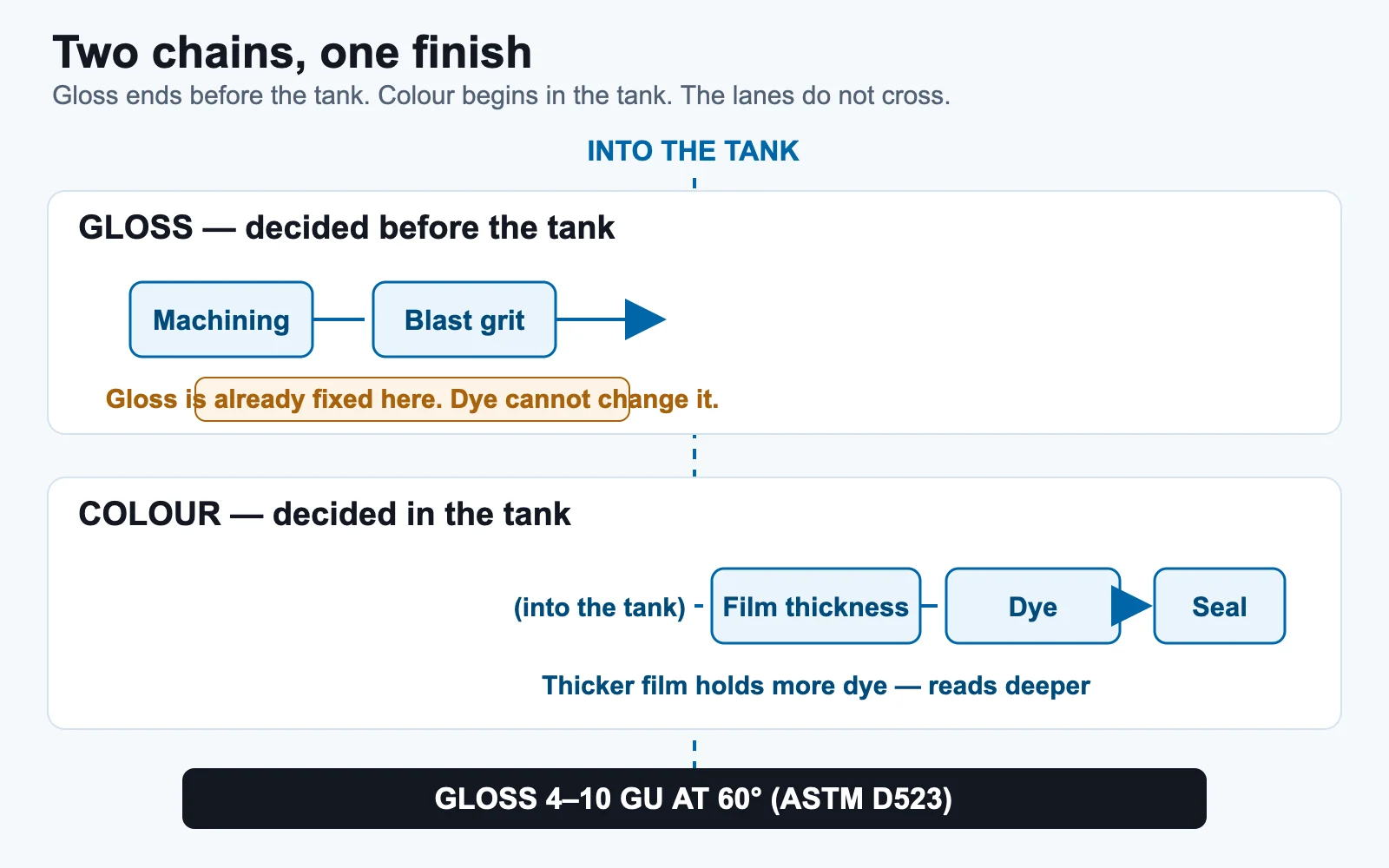
This is the single most common surprise on a black anodize order. The customer writes “matte black anodize”, the shop machines a normally good surface, the finisher does correct Type II Class 2 work, and the part arrives with a sheen nobody wanted.
The controls, in the order they act:
| Pre-anodize condition | How the black reads | Notes |
|---|---|---|
| As-machined, fine finishing pass | Semi-gloss, and directional | Tool marks visible as differences in sheen |
| Bead blast, fine grit | Even matte with a slight sheen | Common for instrument and consumer housings |
| Bead blast, coarse grit | Deep matte, visibly textured | Hides machining completely; can look grainy |
| Grained / brushed | Satin with a direction | Direction becomes a drawing requirement |
| Polished | Gloss black | Shows every substrate defect |
Two practical consequences:
- Write the texture, not the feeling. “Matte” is a judgment; a blast grit or an Ra range is an instruction. Stating both a gloss range and the texture that produces it gives the finisher a target and a method.
- Gloss is measured, not argued. Gloss meters read in gloss units at a stated geometry — 60° is the usual one for finishes in this range, per ASTM D523. A drawing line such as
GLOSS 4–10 GU AT 60°is inspectable. Confirm the range against a sample before it goes on a production drawing; the achievable band depends on the blast media and the part geometry.
Why the second batch looks different
Color drift on black anodize is normal process variation made visible, and it has four main sources. Naming which ones matter for your part is how a drawing controls it.
1. Film thickness. A dyed film gets its color from dye held in the pores of the oxide. A thicker film holds more dye and reads deeper and denser; a thin film reads washed out, sometimes with a brown or gray cast. Thickness varies across a part and between racks — sharp edges and outside corners build differently from recessed faces. Specifying a thickness range is a color control, not just a corrosion control.
2. Dye bath condition. Organic dye baths age, get diluted, and are replenished. Two batches months apart are not the same bath.
3. Seal quality. Sealing closes the pores and locks the dye in. A poor or interrupted seal can leach dye and shift the color, and it also costs corrosion resistance — so a color complaint is sometimes a seal problem wearing a cosmetic disguise.
4. Alloy and temper. 6061 is the reliable substrate for dyed cosmetic black. 7075 tends toward a less uniform, yellower-cast result, and copper-bearing 2024 is worse. Castings with high silicon go gray and blotchy. A mixed-alloy assembly will not color-match, which is covered from the alloy side in 6061 vs 7075.
The control that works in practice is an approved limit sample: a physical part, agreed by both sides, that defines the acceptable extremes of color and gloss. Written color tolerances such as a ΔE limit are more precise and are worth it on high-volume consumer work, but they require an agreed measurement geometry and a reference standard, and they do not replace a sample for judging texture.
Type II black and Type III black are different products
Type II dyed black is a color applied to a thin film. Type III hardcoat is a thick, hard film whose color comes from the film itself. They look different, wear differently and cost differently — and “black anodize” on a drawing does not say which one you mean.
| Type II Class 2, dyed black | Type III hardcoat | |
|---|---|---|
| Where the color comes from | Organic dye in the pores | The film itself; dyeing only deepens it |
| Typical thickness | 10–25 µm | 25–50 µm |
| Color achievable | True, even black | Dark gray to near-black, less uniform |
| Color consistency | Good on 6061 with control | Inherently more variable |
| Wear resistance | Modest | High — this is its purpose |
| Dimensional impact | Small but real | Significant; plan it into fits |
| Right for | Cosmetic housings, panels, consumer-facing parts | Wear faces, sliding surfaces, structural parts |
If the part is a visible housing, Type II Class 2 is almost always the answer. If the part slides or takes abrasion, Type III is, and its appearance has to be accepted as a consequence rather than specified as a color. The hardcoat guide covers the functional side, including the dimensional growth that catches people out.
Fade, and where black is the wrong choice
Organic dyes fade under ultraviolet light. A black anodized part that lives outdoors or under strong UV will lighten and shift, usually toward brown or purple, over a timescale that depends on the dye, the film and the exposure.
What to do about it:
- Say the part sees sunlight. Finishers have dye systems with better light-fastness, and they cannot choose one if nobody mentions the environment.
- Ask for a thicker film. More film and more dye slows the visible shift.
- Check the seal specification. Sealing matters for both fade and corrosion.
- Consider whether black is required at all. For outdoor structural parts, a hardcoat or a painted system may hold appearance longer than dyed Type II.
For indoor equipment — which is most robot, instrument and electronics work — dyed black is stable enough that this is a non-issue. It becomes an issue exactly when nobody thought to raise it.
Masking, threads and fits
Dyed black is thin enough that many parts are anodized all over. Where it does need masking, it is for the same reasons as any anodize:
- Grounding and bonding pads — anodize insulates.
- Close fits and dowel holes — the film grows about half its thickness per surface, so a hole closes by roughly the film thickness on diameter.
- Sliding or sealing faces where the surface texture is functional.
State masked areas as a list, and state whether toleranced dimensions apply before or after coating. That one line removes the most common source of post-finish rework. The anodize design checklist covers the design side.
What goes on the drawing
- Finish spec, type and class —
MIL-A-8625 TYPE II CLASS 2, BLACK, SEALED
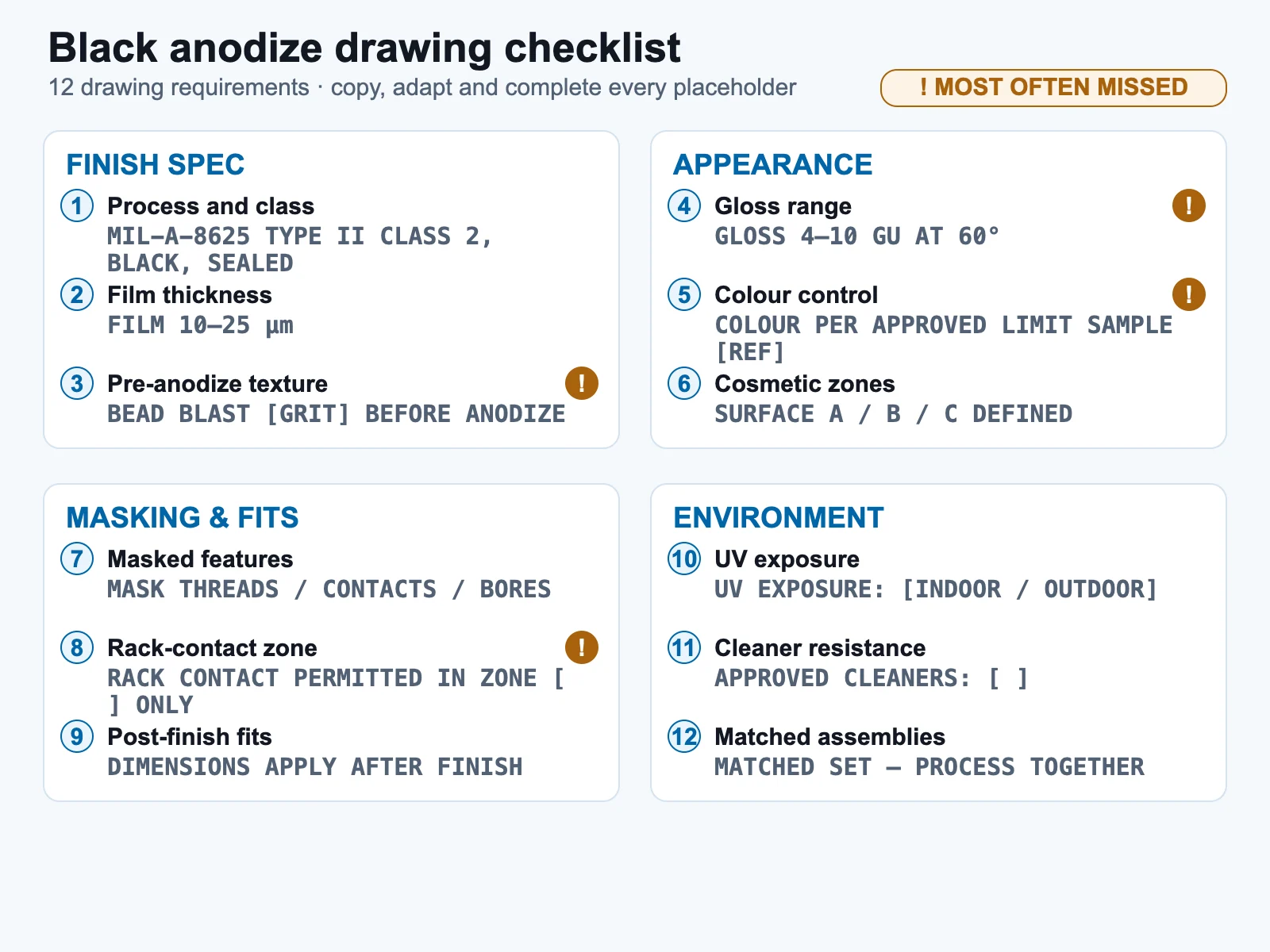
Items 3, 4, 5 and 8 are the ones that decide whether “matte black” means the same thing to both sides.
Common mistakes
- Specifying “matte” with no texture call. The dye cannot change gloss; the surface underneath does.
- Treating film thickness as corrosion-only. It is the main color-depth control.
- Writing “black anodize” without Type and Class, so Type II and Type III are both compliant answers.
- Expecting color match across alloys. 6061, 7075 and castings will not match under the same dye.
- No limit sample on recurring work. Every batch then gets judged against a memory.
- Not mentioning outdoor use, then reporting fade as a defect.
- Unmasked grounding pads on an insulating finish.
- Blaming the finisher for a machining witness line that a coarser blast would have hidden.
FAQ
How do you get a matte black anodized finish rather than a glossy one?
By controlling the surface before anodizing, not the anodizing. Bead blast the part to a stated grit; a finer grit gives an even matte with slight sheen and a coarser grit gives a deeper, more textured matte. Then state a gloss range at 60° on the drawing so the result is measurable rather than a matter of opinion.
Why does black anodize vary from batch to batch?
Four usual causes: film thickness differences, which change how much dye the film holds and therefore how deep the black reads; dye bath age and replenishment; seal quality; and substrate alloy. Control the first with a thickness range, and control the rest with an approved limit sample that defines the acceptable extremes.
What is the difference between Type II black and Type III black?
Type II Class 2 is a thin film colored with an organic dye, giving a true, even black — the right choice for cosmetic parts. Type III hardcoat is a thick, hard film whose dark gray to near-black color comes from the film itself; it is chosen for wear resistance, and its appearance is less uniform and harder to match.
Will black anodized aluminum fade?
Organic dyes fade under ultraviolet light, typically shifting toward brown or purple. Indoors this is rarely an issue. For outdoor or high-UV service, say so on the RFQ so a more light-fast dye system and a thicker film can be selected, and consider whether a different finish system suits the life you need.
Can you specify black anodize color with a number?
You can, using a ΔE limit against a named reference under an agreed measurement geometry, and it is worth doing on high-volume consumer work. It does not replace a physical limit sample, because a number does not capture texture or gloss, and both affect how the color is perceived.
Does black anodize change part dimensions?
Yes. The film grows about half its thickness outward on each surface, so an external dimension grows by roughly the film thickness and a hole closes by roughly the film thickness on diameter. On a 10–25 µm Type II film this matters for close fits and dowel holes. Mask them, or state that dimensions apply after coating.
Conclusion
“Matte black anodize” is two specifications wearing one name. The matte half is machining and blasting, settled before the part is racked. The black half is dye, thickness and seal, and it drifts unless something physical defines the target.
Put a texture, a gloss range, a thickness range and a limit sample on the drawing and both halves become inspectable. Send the part drawing with a note about where it will live, and we will return a finish and masking review before the first batch sets the expectation.