
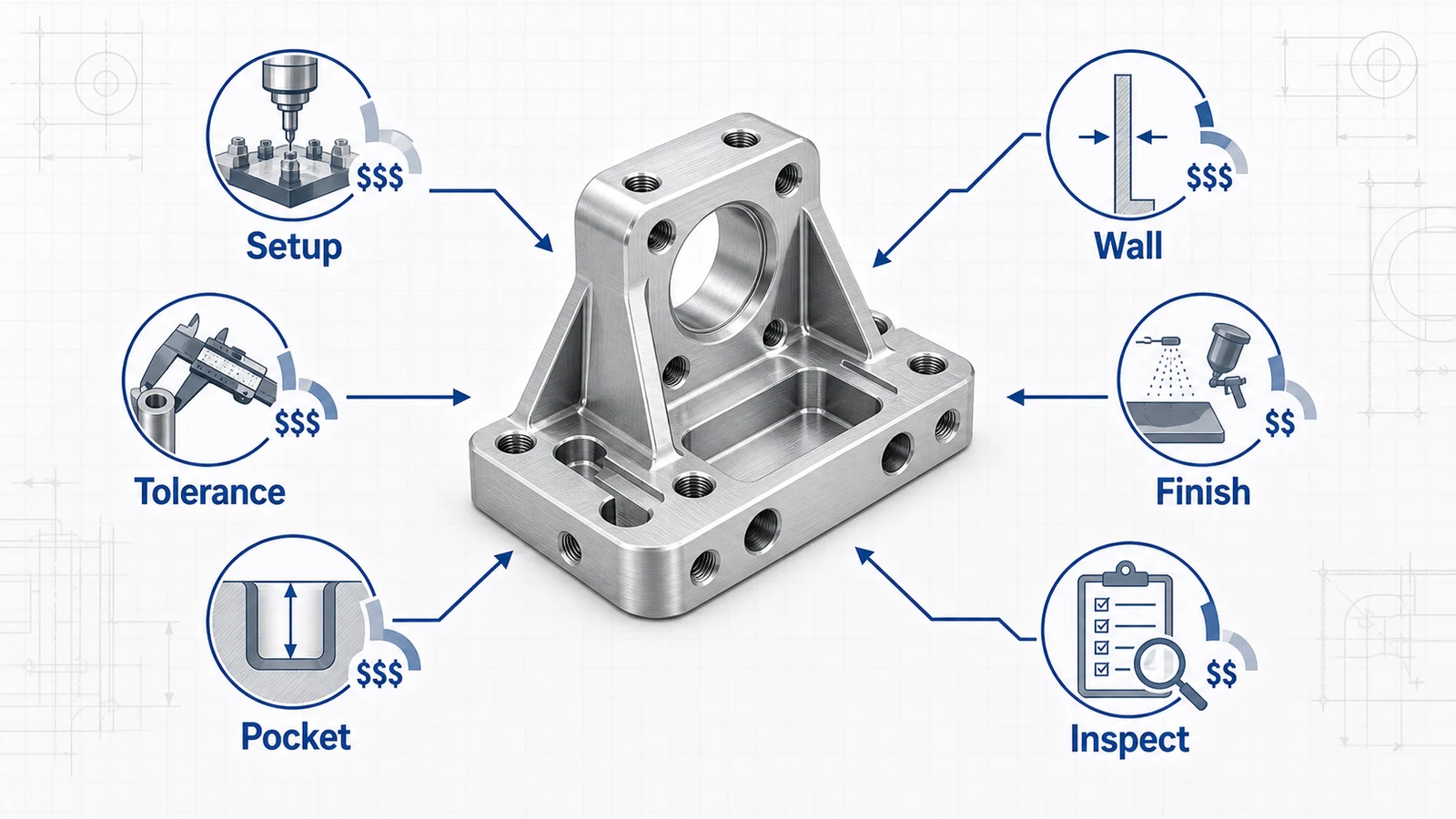
The fastest way to reduce aluminum CNC machining cost is not to ask for a cheaper hourly rate. It is to remove avoidable manufacturing work from the part. Aluminum machines efficiently, but cost still rises when a design needs extra setups, deep pockets, tiny cutters, tight tolerances, cosmetic finishing, special material, or heavy inspection.
Good cost reduction protects the function of the part. Bad cost reduction removes features blindly and creates assembly problems later. The goal is to identify which surfaces, holes, fits, and finishes truly matter, then make the rest easier to machine.
Main cost drivers in aluminum CNC machining
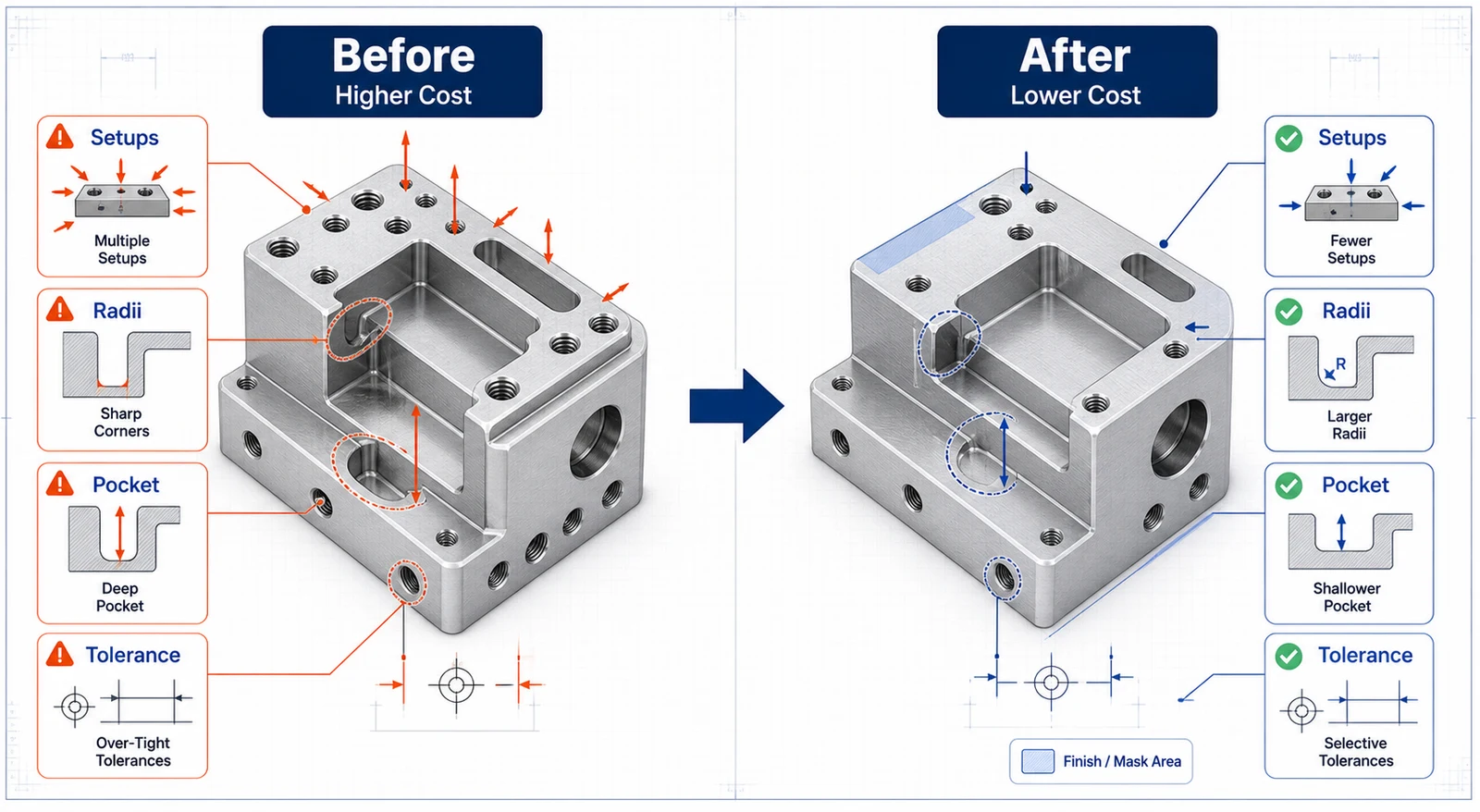
| Cost driver | Why it adds cost | Practical reduction method |
|---|---|---|
| Setup count | Every side and fixture adds time and risk | Combine features by access direction where possible |
| Tight tolerances | Slower cutting and more inspection | Tighten only functional features |
| Deep pockets | Long tools, chatter risk, slower roughing | Increase radii, reduce depth, or split parts |
| Thin walls | Light cuts and distortion control | Increase thickness or add support ribs |
| Cosmetic finishing | Extra handling, masking, and rejection risk | Define visible faces and acceptable range |
| Special inspection | CMM time and reporting | Specify reports for critical dimensions only |
Use this table before release. If a feature does not serve assembly, load, sealing, thermal transfer, or appearance, it may be a cost target.
Reduce setups before changing material
Setup count is one of the largest cost drivers. A simple 6061 part that can be machined from two sides may cost less than a smaller part requiring five orientations, custom soft jaws, and careful re-indicating.
Review the CAD model by access direction. Can all threaded holes be reached from the top? Can side holes become through holes from a primary face? Can a cosmetic chamfer be replaced with a deburred edge? Can a boss move slightly so the cutter reaches it without an extra setup?
This is where 3-axis vs 5-axis aluminum CNC machining matters. A 5-axis machine can reduce setups on complex parts, but it is not automatically cheaper. The right process depends on whether the higher machine rate saves enough fixture and inspection time.
Loosen tolerances where function allows
Aluminum can be machined accurately, but tight tolerances still cost money. A +/-0.02 mm slot requires a different plan than a clearance pocket. It may need tool wear control, spring passes, in-process measurement, temperature awareness, and more inspection.
A useful drawing separates critical and non-critical features. For example:
- Dowel holes: tight position and fit.
- Bearing bore: tight diameter and roundness.
- Mounting face: flatness and perpendicularity.
- Outside profile: standard tolerance.
- Internal clearance pocket: standard tolerance.
Do not use a tight title-block tolerance if only two features matter. That makes the entire part expensive.
Choose the right aluminum alloy
6061-T6 is usually the lowest-risk default for cost-sensitive aluminum CNC parts. It is available, machines well, and anodizes predictably. 7075 is justified when strength-to-weight ratio matters. MIC-6 is justified when flatness and stability matter. 5052 may be useful for some sheet-like parts but is not always the best choice for heavy milling.
Material cost is only one piece. A harder-to-source alloy can add lead time. A poor anodizing match can add cosmetic rejects. A material that moves after machining can add rework. Review the aluminum CNC material guides before assuming the cheapest raw material creates the cheapest finished part.
Design pockets and radii for real tools
Internal corners are made by round cutters. A sharp internal corner requires EDM, broaching, manual work, or a very small cutter that adds cycle time. Use the largest internal radius that the assembly allows. For pocket floors, avoid narrow deep slots where chips cannot evacuate well.
If weight reduction is the goal, large open pockets with generous radii are better than many small decorative pockets. For heat sinks, leave enough spacing between fins for tooling and deburring. For housings, keep wall thickness consistent so the part remains stable.
Make finishing a controlled requirement
Anodizing, bead blasting, laser marking, and masking all add value, but vague finish notes add cost. “Black anodize, cosmetic” can mean different things to engineering, purchasing, and finishing. A better note defines type, color, thickness, visible faces, masking, and whether small rack marks are acceptable on hidden areas.
If a surface is hidden after assembly, do not require cosmetic perfection there. If a bore or threaded hole must remain dimensionally controlled, specify masking or post-finish machining. Clear finishing notes reduce back-and-forth and lower rejection risk.
Improve the RFQ package
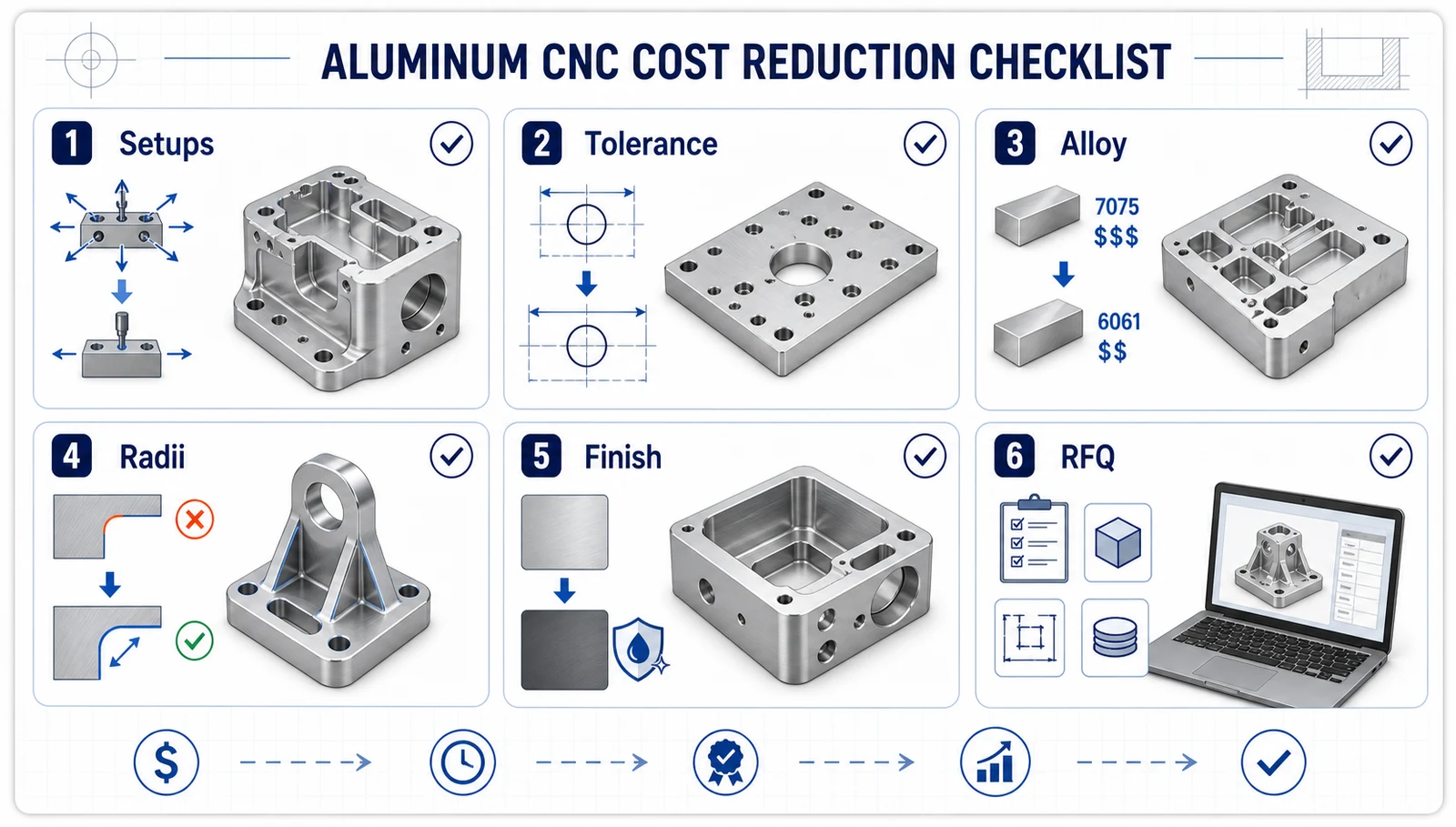
A complete RFQ can reduce cost because it reduces uncertainty. Send STEP, PDF, quantity, alloy, finish, tolerance requirements, target lead time, and application notes. If you only send a model, the supplier must guess which dimensions matter and may quote conservatively.
For repeat orders, include forecast volume and batch size. A prototype route may be different from a production route. If the supplier knows the part will repeat, they can consider better fixturing, blank preparation, or inspection methods that reduce long-term unit cost.
Cost reduction is not a single trick. It is the result of a clear design, a realistic drawing, a manufacturable finish, and an RFQ package that tells the supplier what to protect.